Today’s residential homebuilders are operating in a remarkably complex market. Elevated mortgage rates, stubborn construction costs, and a pressing home affordability crisis have slowed sales velocity and forced builders to rethink traditional incentives. In recent years, builders have relied on design center credits or mortgage rate buy-downs to attract buyers. However, these are short term fixes that directly dilute a builder’s margins.
Forward-thinking builders can now shift their strategy from these buyer concessions to a permanent reduction in a home’s monthly operating costs. In the Greater Houston area, energy has become one of a household’s largest operational expenses outside of the mortgage payment itself. By rethinking how communities are powered, builders can fundamentally lower this ongoing cost for homeowners while securing a distinct competitive advantage.
Through a strategic partnership in Texas with Reliant Energy, Sunrun is deploying a modern grid infrastructure solution: the Distributed Power Plant (DPP). A DPP networks individual residential battery systems into a coordinated, utility-scale asset that can dispatch stored energy back to the grid when demand peaks. By leveraging a monthly subscription model, Sunrun New Homes provides builders a zero-cost package including in-home battery storage, on-site rooftop power generation and a SPAN smart electrical panel. Additionally, this package has no upfront cost for homebuyers. In turn, they pay a monthly fee to Sunrun for the solar energy produced & stored by their system providing long term predictability of their electricity cost & reliable back up power during outages. Any additional household energy consumed outside of the Sunrun system is pulled from the grid.
The Macro Pressures Driving Houston’s Energy Shift
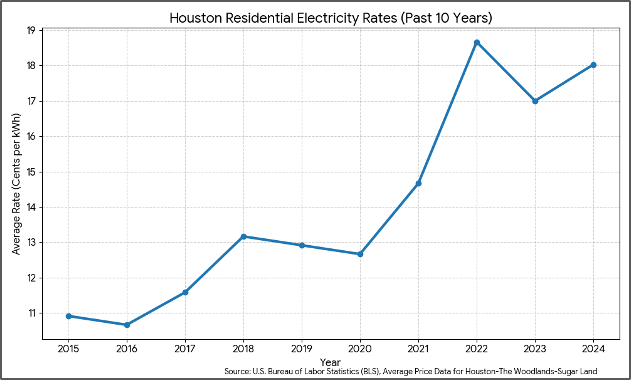
In Houston, skyrocketing utility rates and grid instability are heavily weighing down household budgets. According to data from the U.S. Bureau of Labor Statistics, local residential electricity rates have climbed by an average of 5% annually over the last five years1. Looking ahead, market projections suggest rates could surge an additional 30% by 2030, moving from roughly $0.15/kWh to $0.20/kWh2.
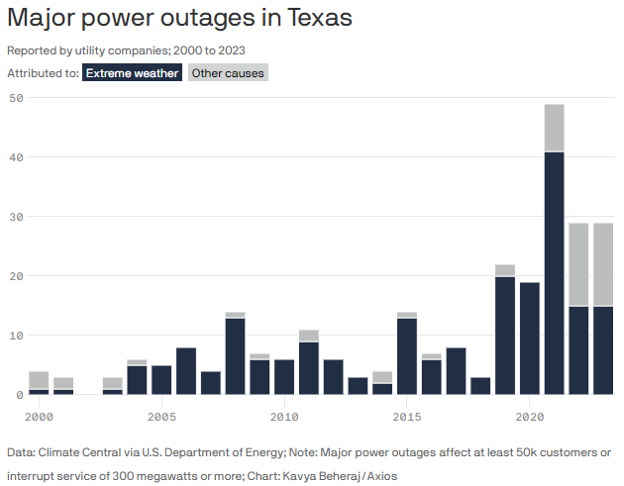
Compounding these rising costs is a sharp decline in grid reliability. Power outages have become increasingly frequent, rising 784% from 2014 to 2024 based on U.S. Energy Information Administration (EIA) data. These challenges place a heavy emotional and financial burden on homeowners and new construction builders are uniquely positioned to address them.
1 https://www.eia.gov/electricity/annual/html/epa_11_04.html
2 https://www.eia.gov/electricity/annual/html/epa_11_04.html
Historically, integrating a comprehensive solar-plus-storage system to hedge against these rate hikes and power outages meant adding $20,000 or more to the cost of a home. In a tight affordability environment, rolling that hardware expense into a 30-year mortgage inflates the home's final price tag, increases the required down payment, and can disqualify price-sensitive buyers.
Sunrun’s subscription model bypasses this financial barrier. Under this framework, energy generation and battery storage hardware are integrated directly into the home during the construction phase at no cost to the builder and $0 down for the homebuyer. Because the system operates as a monthly service rather than a capital expenditure, it avoids increasing the home's purchase price. Homebuyers pay a monthly fee to Sunrun and secure locked-in rates for the solar energy produced by their roof for a 25-year term, alongside reliable backup power.
When the broader utility grid experiences extreme demand strain, Sunrun can remotely orchestrate the dispatch of a portion of the stored energy from the home battery back to the grid to support local infrastructure. In recognition of this grid service, participating homeowners receive fixed, monthly bill credits on their Sunrun subscription statements. To ensure homeowner peace of mind, the system is designed to retain a minimum 20% energy reserve exclusively for home backup power during these dispatch events.
The Builder’s Perspective: Differentiation and Execution
With multiple production builders often competing within the same communities, standing out requires a compelling, tangible value proposition. Standard energy-efficiency upgrades are viable and make an impact, but only go so far with buyers in today’s market. To capture the modern consumer in Houston, offering true energy resilience provides a much stronger narrative.
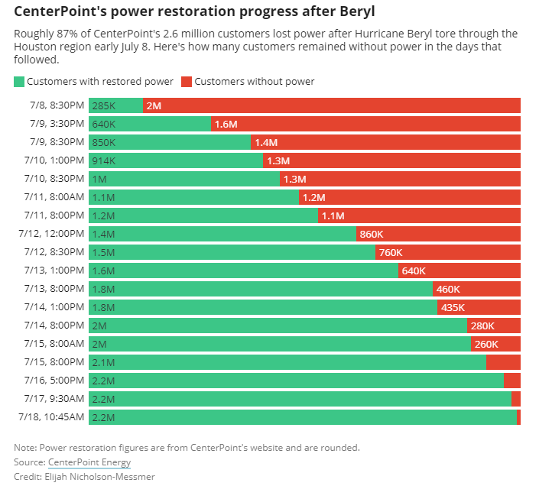
A University of Houston study revealed that 88% of Houston-area residents are actively worried about extended power outages during the summer months, and 87% have already suffered negative consequences from localized grid failures3. Despite this overwhelming consumer sentiment, fewer than 2% of real estate listings in the Greater Houston area currently feature solar or storage assets4.
3 https://www.uh.edu/hobby/txtrends/energy.pdf&sa=D&source=docs&ust=1770065250852425&usg=AOvVaw1wVhhxj9DkqpdPQ14I5xxR
4 According to Zillow.com January 27, 2026
By standardizing energy resilience via battery storage, sales teams can provide buyers with a concrete guarantee: when the next major storm or heat wave triggers a power outage, their lights will stay on, and their food will stay preserved.
Beyond the marketing advantages, these systems unlock financial incentives for builders. Sunrun leverages the Section 48E Investment Tax Credit (ITC) which includes a 30% base credit, a 10% domestic content adder for utilizing domestically manufactured hardware, and a 10% adder for Houston qualifying as an "Energy Community" due to its historical ties to the fossil fuel industry. By monetizing this 50% tax credit stack through the subscription model, Sunrun is able to pass value back to the builder through per-home volume rebates that boost project margins without adding construction costs or a purchase price increase to the homebuyer.
To eliminate operational friction and avoid construction delays, Sunrun’s dedicated New Homes business unit provides full turnkey execution with the sole focus of serving production homebuilders. Their team manages the entire project lifecycle internally from engineering design and local permitting to utility interconnection and final system activation. Installations are fulfilled utilizing 100% W2 crews from their Houston operations center, ensuring strict compliance with building codes, project schedules and safety. Once the home is closed and the system is activated, Sunrun provides ongoing, 25-year warranty, operations, and maintenance support.
In an evolving housing market defined by affordability pressures and heightened grid & energy awareness, standardizing energy resilience offers builders a rare opportunity to provide reliable back up power, drive traffic to communities with strategic marketing and future-proof their homes.
Learn More at Our Upcoming Webinar, Powering Houston: Differentiating New Homes with Distributed Energy on 7/16/26 at 2:00 PM CT.
** Learn More About Sunrun New Homes**
**Learn More About Sunrun & NRG's Partnership**